|
-1 | ||
|
Our
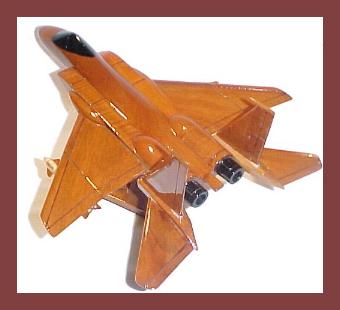
F-15 Eagle natural wood model comes highly detailed. The wooden model airplane
comes complete with display stand and Measures 17" long 14" wide and
stands 8" tall on the stand. All of our model aircraft can be hung from the
ceiling using fishing line. F-15
Eagle History and Statistics The F-15's superior maneuverability and acceleration are achieved through high engine thrust-to-weight ratio and low wing loading. Low wing-loading (the ratio of aircraft weight to its wing area) is a vital factor in maneuverability and, combined with the high thrust-to-weight ratio, enables the aircraft to turn tightly without losing airspeed. A multimission avionics system sets the F-15 apart from other fighter aircraft. It includes a head-up display, advanced radar, inertial navigation system, flight instruments, UHF communications, tactical navigation system and instrument landing system. It also has an internally mounted, tactical electronic-warfare system, "identification friend or foe" system, electronic countermeasures set and a central digital computer. Through an on-going multistage improvement program the F-15 is receiving extensive upgrade involving the installation or modification of new and existing avionics equipment to enhance the tactical capabilities of the F-15. The head-up display projects on the windscreen all essential flight information gathered by the integrated avionics system. This display, visible in any light condition, provides the pilot information necessary to track and destroy an enemy aircraft without having to look down at cockpit instruments. The F-15's versatile pulse-Doppler radar system can look up at high-flying targets and down at low-flying targets without being confused by ground clutter. It can detect and track aircraft and small high-speed targets at distances beyond visual range down to close range, and at altitudes down to tree-top level. The radar feeds target information into the central computer for effective weapons delivery. For close-in dog fights, the radar automatically acquires enemy aircraft, and this information is projected on the head-up display.
The F-15's electronic warfare system provides both threat warning and automatic countermeasures against selected threats. The "identification friend or foe" system informs the pilot if an aircraft seen visually or on radar is friendly. It also informs U.S. or allied ground stations and other suitably equipped aircraft that the F-15 is a friendly aircraft.
The Eagle can be armed with combinations of four different air-to-air weapons: AIM-7F/M Sparrow missiles or AIM-120 Advanced Medium Range Air-to-Air Missiles on its lower fuselage corners, AIM-9L/M Sidewinder or AIM-120 missiles on two pylons under the wings, and an internal 20mm Gatling gun (with 940 rounds of ammunition) in the right wing root.
The
first F-15A flight was made on 27 July 1972, culminating one of the most successful
aircraft development and procurement programs in Air Force history. After an accident-free
test and evaluation period, the first aircraft was delivered to the Air Force
on Novermber 14, 1974. In January 1976, the first Eagle destined for a combat
squadron was delivered to the 1st Tactical Fighter Wing at Langley Air Force Base,
Va. Three hundred and sixty-five F-15As were built before production of the F-15C
began in 1978. In January 1982, the 48th Fighter-Interceptor Squadron at Langley
Air Force Base became the first Air Force air defense squadron to transition to
the F-15. After twenty years of service, the F-15A has recently been reassigned
from active duty Air Force fighter squadrons to Air National Guard units. The
F-15A is flown by Air National Guard squadrons in the states of Oregon, Missouri,
Georgia, Louisiana, Hawaii, and Massachussets. The F-15C has an air combat victory ratio of 95-0 making it one of the most effective air superiority aircraft ever developed. The US Air Force claims the F-15C is in several respects inferior to, or at best equal to, the MiG-29, Su-27, Su-35/37, Rafale, and EF-2000, which are variously superior in acceleration, maneuverability, engine thrust, rate of climb, avionics, firepower, radar signature, or range. Although the F-15C and Su-27P series are similar in many categories, the Su-27 can outperform the F-15C at both long and short ranges. In long-range encounters, with its superiorr radar the Su-27 can launch a missile before the F-15C does, so from a purely kinematic standpoint, the Russian fighters outperform the F-15C in the beyond-visual-range fight. The Su-35 phased array radar is superior to the APG-63 Doppler radar in both detection range and tracking capabilities. Additionally, the Su-35 propulsion system increases the aircraft’s maneuverability with thrust vectoring nozzles. Simulations conducted by British Aerospace and the British Defense Research Agency compared the effectiveness of the F-15C, Rafale, EF-2000, and F-22 against the Russian Su-35 armed with active radar missiles similar to the AIM-120 Advanced Medium Range Air-to-Air Missile (AMRAAM). The Rafale achieved a 1:1 kill ratio (1 Su-35 destroyed for each Rafale lost). The EF-2000 kill ratio was 4.5:1 while the F-22 achieved a ratio of 10:1. In stark contrast was the F-15C, losing 1.3 Eagles for each Su-35 destroyed. F-15E Strike Eagle Although the slogan of the F-15's original
design team was "Not a pound for air-to-ground," the F-15 has long been
recognized as having superior potential in the ground attack role. In 1987 this
potential was realized in the form of the F-15E Strike Eagle. The mission of the
Strike Eagle is as succinct as that of its air-to-air cousin: to put bombs on
target. The F-15E is especially configured for the deep strike mission, venturing
far behind enemy lines to attack high value targets with a variety of munitions.
The Strike Eagle accomplishes this mission by expanding on the capabilities of
the air superiority F-15, adding a rear seat WSO (Weapon Systems Operator) crewmember
and incorporating an entirely new suite of air-to-ground avionics. Conformal Fuel Tanks were introduced with the F-15C in order to extend the range of the aircraft. The CFTs are carried in pairs and fit closely to the side of the aircraft, with one CFT underneath each wing. By designing the CFT to minimize the effect on aircraft aerodynamics, much lower drag results than if a similar amount of fuel is carried in conventional external fuel tanks. This lower drag translate directly into longer aircraft ranges, a particularly desirable characteristic of a deep strike fighter like the F-15E. As with any system, the use of CFTs on F-15s involves some compromise. The weight and drag of the CFTs (even when empty) degrades aircraft performance when compared to external fuel tanks, which can be jettisoned when needed (CFTs are not jettisonable and can only be downloaded by maintenance crews). As a result, CFTs are typically used in situations where increased range offsets any performance drawbacks. In the case of the F-15E, CFTs allow air-to-ground munitions to be loaded on stations which would otherwise carry external fuel tanks. In general, CFT usage is the norm for F15Es and the exception for F-15C/D's. The F-15E Strike Eagle’s tactical electronic warfare system [TEWS] is an integrated countermeasures system. Radar, radar jammer, warning receiver and chaff/flare dispenser all work together to detect, identify and counter threats posed by an enemy. For example, if the warning receiver detects a threat before the radar jammer, the warning receiver will inform the jammer of the threat. A Strike Eagle’s TEWS can jam radar systems operating in high frequencies, such as radar used by short-range surface-to-air missiles, antiaircraft artillery and airborne threats. Current improvements to TEWS will enhance the aircraft’s ability to jam enemy radar systems. The addition of new hardware and software, known as Band 1.5, will round out the TEWS capability by jamming threats in mid-to-low frequencies, such as long-range radar systems. The equipment is expected to go into full production sometime in late 1999. The Defense Department plans to sustain production of the F-15E for at least two more years, purchasing three aircraft in both FY 1998 and FY 1999. Without FY 1998 procurement, the F-15 production line would begin to close in the absence of new foreign sales. These six additional aircraft, together with the six aircraft approved by Congress in FY 1997, will sustain the present 132-plane combat force structure until about FY 2016. Under current plans by 2030, the last F-15C/D models will have been phased out of the inventory and replaced by the F-22. Service Life Designed in the 1960s and built in the 1970s, the F-15A - D aircraft has now been in service for over twenty years. While the Eagle's aerodynamics and maneuverability are still on a par with newer aircraft, quantum leaps in integrated circuit technology have made the original F-15 avionics suite obsolete. The objective of the Multi-Stage Improvement Program (MSIP) was to set the Eagle in step with today's vastly improved information processing systems. Some F-15C/D aircraft (tail numbers 84-001 and higher) came off the assembly line with MSIP in place. All F-15A/B/C/D aircraft produced before 84-001 will receive the MSIP retrofit at the F-15 depot. Improvements incorporated via MSIP vary between F-15A/B and F-15C/D aircraft; the C/D MSIP has been completed. However, all air-to-air Eagles gain improved radar, central computer, weapons and fire control, and threat warning systems. The purpose of the F-15 Multi-stage
Improvement Program (MSIP) was to provide maximum air superiority in a dense hostile
environment in the late 1990s and beyond. All total, 427 Eagles received the new
avionics upgrades. Along with later model production aircraft, these retrofitted
aircraft would provide the Combat Air Forces (CAF) with a total MSIP fleet of
526 aircraft. The MSIP upgraded the capabilities of the F-15 aircraft to included
a MIL-STD-1760 aircraft/weapons standard electrical interface bus to provide the
digital technology needed to support new and modern weapon systems like AMRAAM.
The upgrade also incorporated a MIL-STD-1553 digital command/response time division
data bus that would enable onboard systems to communicate and to work with each
other. A new central computer with significantly improved processing speed and
memory capacity upgraded the F-15 from 70s to 90s technology, adding capacity
needed to support new radar and other systems. The original Eagle had less computer
capacity than a 1990s car. Some of the work prefaced the addition of the Joint
Tactical Information Distribution System, adding space, power, and cooling that
would allow the new avionics to run in the harsh environments in which the Eagle
operates. The new programmable armament control set (PACS) with a multi-purpose
color display (MPCD) for expanded weapons control, monitoring, and release capabilities
featured a modern touch screen that allowed the pilot to talk to his weapons.
A data transfer module (DTM) set provided pre-programmed information that customized
the jet to fly the route the pilot had planned using mission planning computers.
An upgrade to the APG-63 Radar for multiple target detection, improved electronic
counter-countermeasures (ECCM) characteristics, and non-cooperative target recognition
capability enabled the pilot to identify and target enemy aircraft before he was
detected or before the enemy could employ his weapons. An upgrade of the advanced
medium range air-to-air missile (AMRAAM), that carried up to eight missiles, represented
an improvement that complimented the combat-proven AIM-7 Sparrow by giving the
pilot capability to engage multiple targets to launch and leave, targeting and
destroying enemy fighters before they could pose a threat. The upgraded Radar
Warning Receiver (RWR) and an enhanced internal countermeasures set (ICS) on F-15C/D
models improved threat detection and self-protection radar jamming capability
that allowed pilots to react to threat and to maneuver to break the lock of enemy
missiles. Full-scale fatigue testing between 1988 and 1994 ended with a demonstration of over 7,600 flight hours for the most severely used aircraft, and in excess of 12,000 hours on the remainder of the fleet. A 10,000-hour service limit would provide F-15Cs to 2020, while a 12,000-hour service life extends the F-15Cs to the year 2030. The APG-63 radar, F100-PW-100 engines, and structure upgrades are mandatory. The USAF cannot expect to fly the F-15C to 2014, or beyond, without replacing these subsystems. The total cost of the three retrofits would be under $3 billion. The upgrades would dramatically reduce the 18 percent breakrate prevalent in the mid-1990s, and extend the F-15C service life well beyond 2014. The F-15E structure is rated at 16,000 flight hours, double the lifetime of earlier F-15s. Foreign Military Sales F-15I Thunder Israel has bought F-15A, B, and D aircraft from USAF inventories and is currently obtaining an air-to-ground version called the F-15I. The two seat F-15I, known as the Thunder in Israel, incorporates new and unique weapons, avionics, electronic warfare, and communications capabilities that make it one of the most advanced F-15s. The F-15I, like the US Air Force's F-15E Strike Eagle, is a dual-role fighter that combines long-range interdiction with the Eagle's air superiority capabilities. All aircraft are to be configured with either the F100-PW-229 or F110-GE-129 engines by direct commercial sale; Night Vision Goggle compatible cockpits; an Elbit display and sight helmet (DASH) system; conformal fuel tanks; and the capability to employ the AIM-120, AIM-7, AIM-9, and a wide variety of air-to-surface munitions. F-15
production, which began in 1972, has been extended into 1999 by orders F-151 aircraft
for Israel. Israel selected the F-15I in January, 1994 after evaluating a variety
of aircraft to meet its defense needs. The government of Israel initially ordered
25 F-15I Thunders, powered by two Pratt & Whitney F100-PW-229 low bypass turbofan
engine. This foreign military sale was valued at $1.76 billion dollars. The Israeli
Air Force received the first two of 25 F-15I aircraft in January 1998. On 22 September
1998 the US Department of Defense announced the sale to the Government of Israel
of 30 F-15I aircraft; 30 AN/APG-70 or AN/APG-63(V)1 radar; and 30 each LANTIRN
navigation and targeting pods. Associated support equipment, software development/integration,
spares and repair parts, flight test instrumentation, publications and technical
documentation, personnel training and training equipment, US Government and contractor
technical and logistics personnel services, and other related requirements to
ensure full program supportability will also be provided. The estimated cost was
$2.5 billion. F-15J Peace Eagle
|
 |
 |
 |